
Meta description: Compare same-day and next-day trash can cleaning routes, including scheduling, exposure, route efficiency, customer reminders, and scaling strategies for residential bin cleaning businesses.
If you’re building a trash can cleaning business, one of the first operational decisions you’ll make is surprisingly simple:
Do you clean residential bins on the same day the waste hauler empties them, or do you return the next day?
This choice affects nearly everything: your start time, route size, drive time, customer communication, missed-bin rate, and even how often homeowners see your branded truck or trailer!
There isn’t one perfect answer for every market. Same-day service can create valuable neighborhood exposure, while next-day service is usually easier to schedule and scale. The best option depends on your local waste-hauler schedule, neighborhood density, route size, and operating goals.
Here’s how we recommend thinking about it.
What Does Same-Day Bin Cleaning Mean?
With same-day service, your bin cleaning route takes place on the same day the local waste hauler collects household trash.
In a perfect scenario, the garbage truck comes through first, the bins are emptied, and you follow behind with your cleaning equipment. You clean the containers while they’re still at the curb, then move to the next street.
Sounds efficient, right? Sometimes it is!
Same-day cleaning can work well when:
- The waste hauler arrives early and follows a predictable schedule
- Your customers live in dense neighborhoods
- You’re operating a smaller route
- You can monitor pickup timing accurately
- You want your branded equipment visible while the neighborhood is already focused on trash day
That last point matters. When the waste hauler is working in the neighborhood, homeowners are already outside moving bins, checking the curb, or watching collection activity. A wrapped truck or trailer working nearby may generate extra questions and leads.
A homeowner might see your equipment and think, “Wait a minute: someone cleans these things?”
That kind of exposure can be helpful, especially when you’re launching a new residential bin cleaning service. However, visibility is a bonus: not a replacement for a consistent marketing system.
The Main Same-Day Challenge: You Can’t Start Whenever You Want
The biggest problem is timing.
You can’t clean a bin before it has been emptied. If the hauler normally arrives at 7:00 a.m., but sometimes shows up at 9:30 a.m. or noon, your workday has to adjust around someone else’s schedule.
That creates several issues:
- You may start later than you prefer
- You may spend time waiting instead of cleaning
- A late waste-hauler route can delay every stop afterward
- Customers may not know exactly when their bin will be accessible
- You may need to reschedule bins that were missed or collected late
- Your total route size may be smaller because your usable workday is compressed
Same-day service can also make route planning more complicated. You may have customers on several streets, but you can’t necessarily visit them in the most efficient order. You have to consider when the hauler will reach each section.
That’s a lot of moving parts for a business that earns money by completing efficient stops!
What Does Next-Day Trash Can Cleaning Mean?
With next-day service, you clean the bins on the day after the waste hauler picks up the trash.
For example:
- Monday: Waste hauler collects trash in Zone A
- Tuesday: You clean the bins in Zone A
- Wednesday: Waste hauler collects trash in Zone B
- Thursday: You clean the bins in Zone B
This schedule separates your business from the hauler’s exact collection time. You still organize routes around municipal pickup days, but you don’t have to wait for the truck to arrive that morning.
That difference is huge!
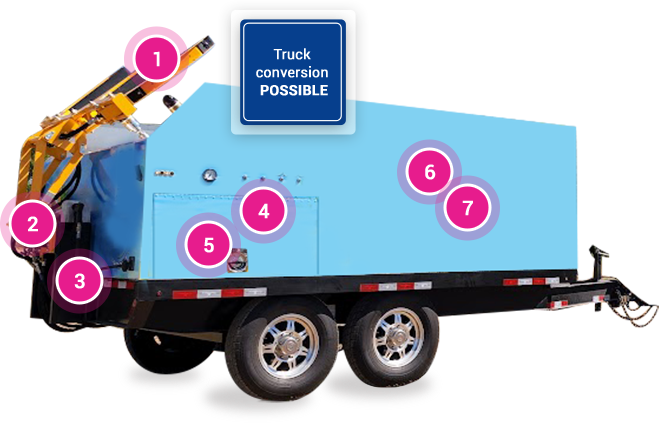
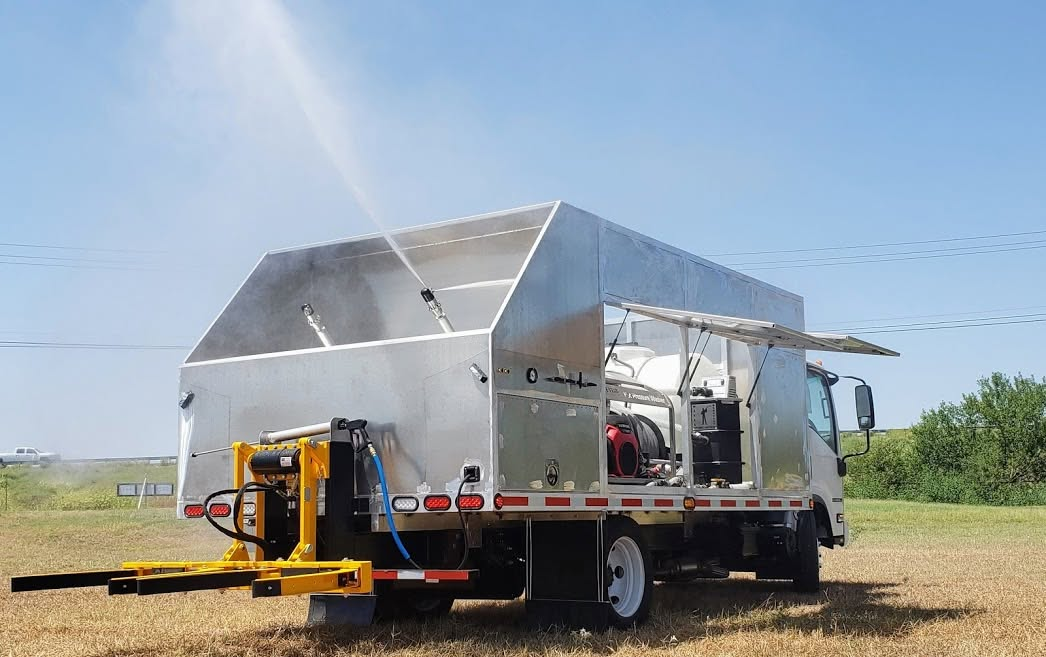
The Viking Upfit TC525T, for example, is designed to clean two bins at a time and includes a 525-gallon clean-water tank, two specialized cleaning heads, water recovery equipment, and a universal lifting arm for 30- to 96-gallon containers. Equipment capacity matters, but your schedule determines how consistently you can use that capacity.
Why Next-Day Routes Are Often Better for Scaling
For most standard residential routes, next-day trash can cleaning is the easier operating model.
Here’s why.
1. You Can Start Earlier
You don’t have to wait for the waste hauler. If your route is ready, you can begin early in the morning and work through a longer, more productive day.
That gives you more time to:
- Complete additional stops
- Handle customer service issues
- Perform maintenance
- Drive between neighborhoods without rushing
- Finish your route before the hottest part of the afternoon
- Add extra services or sales activity later in the day
In this business, every hour matters. One hour spent waiting for a garbage truck is one less hour available for billable work.
2. Your Route Can Be More Linear
Next-day routing allows you to build a cleaner geographic path.
Because every customer in the zone had trash pickup the previous day, it doesn’t matter whether the hauler visited one street at 6:30 a.m. and another street at 11:00 a.m. Both groups are ready for you the next day.
You can simply plan:
- Start at one end of the service area
- Move through the neighborhood street by street
- Minimize backtracking
- Finish at the far end of the route
That makes it easier to create larger total routes. You spend more time cleaning and less time sitting, circling, or returning to a street later.
3. Customer Communication Is More Predictable
Customers generally understand a simple instruction:
“The day after your trash pickup, leave your empty bin at the curb for cleaning.”
Your text reminders, emails, and route notifications can follow a repeatable schedule. That consistency reduces confusion and makes recurring subscriptions easier to manage.
Software can help automate this process. Jobatory is industry-specific software built by bin cleaners for bin cleaners, with tools for scheduling, routing, billing, customer communication, and recurring service management.
The Main Next-Day Challenge: Customers May Bring Bins In
The downside is straightforward: some customers bring their bins back to the house before you arrive.
That can create missed stops, especially if customers assume “trash day” means the cleaning company is coming that same day.
The solution is better communication: not abandoning the next-day model!
Use:
- Text reminders the evening before
- Morning-of reminders
- Clear onboarding instructions
- A visible “leave your bin at the curb” note in the customer portal
- Automatic missed-bin policies
- Optional retrieval and return service
- Follow-up messages when a bin is inaccessible
You can also offer a premium service where your team retrieves the bin from the side of the house, cleans it, and returns it. That requires more labor, so price it accordingly. The important thing is to build the extra movement into your route and your pricing instead of treating it as free work.
Same-Day vs. Next-Day Bin Cleaning: Quick Comparison
| Factor | Same-Day Cleaning | Next-Day Cleaning |
|---|---|---|
| Start time | Usually later or less predictable | Earlier and more consistent |
| Dependence on hauler timing | High | Low |
| Neighborhood exposure | Potentially higher | Still possible, but less tied to trash pickup activity |
| Route size | May be smaller unless density is extremely strong | Often allows larger routes |
| Route design | Can require waiting, backtracking, and timing around the hauler | Easier to build a larger, more linear route |
| Customer instructions | Leave bins out after pickup | Leave bins out an additional day |
| Main risk | Late or unpredictable hauler | Customer brings bin inside |
| Best fit | Dense areas with predictable pickup and strong visibility upside | Best default for most standard residential routes |
When Same-Day Service Makes Sense
Same-day cleaning is not a bad idea. It’s simply more operationally demanding.
We recommend considering it when:
- The hauler follows a highly predictable schedule
- You are working in compact neighborhoods
- Your route has enough density to justify following the collection pattern
- You’re comfortable starting later
- You want additional exposure from working alongside the waste hauler
- You offer same-day as a premium service
- You’re running a smaller route while building your customer base
A small operator with 20 tightly grouped customers may find same-day manageable. A larger route spread across multiple suburbs may quickly become difficult.
The reality is that same-day service often works best when you control the variables: or when you’re willing to charge enough to compensate for the added complexity.
The Hybrid Model: Next-Day Standard, Same-Day Where It Works
You don’t have to choose one model forever.
Many operators can use a hybrid approach:
- Make next-day cleaning your standard residential schedule
- Offer same-day service in neighborhoods with early, predictable pickup
- Use same-day routes for dense promotional campaigns
- Charge an additional fee for special timing
- Test same-day during specific seasons or launch campaigns
- Reserve same-day availability for customers who need it
This gives you the operational stability of next-day routing while allowing you to benefit from same-day exposure when the opportunity is right.
It’s the best of both worlds: without letting the waste hauler run your entire calendar!
Track the Numbers Before You Change Your Schedule
Don’t make this decision based only on how the route feels. Track the results for at least several service cycles.
Compare same-day and next-day performance using:
- Stops completed per hour
- Total route revenue
- Average drive time between stops
- Waiting time
- Missed bins
- Reschedules
- Customer complaints
- Fuel usage
- Leads generated from neighborhood visibility
- New recurring customers
- Revenue per workday
Here’s a simple example: If a route produces $1,000 in revenue, but same-day timing causes two hours of waiting and extra driving, the route may be less profitable than a next-day route producing slightly less gross revenue with much better productivity.
The goal isn’t to look busy. The goal is to build a route that produces reliable profit!
Our Recommendation for a Residential Trash Can Cleaning Business
For most operators, we recommend starting with next-day residential bin cleaning as your standard model.
And just as important, this recommendation comes from firsthand experience, not theory. Viking Upfit's own service business operated with same-day cleaning, so we’ve lived the pros and cons in the real world. If we were starting over from scratch, the owner's personal preference would be next-day cleaning as the default starting point because it simply makes scheduling easier, allows earlier starts, creates longer usable workdays, and supports larger, more linear routes.
It generally provides:
- Earlier starts
- Longer workdays
- More predictable customer communication
- More linear routes
- Less waiting
- Less backtracking
- Better scalability
Same-day service can absolutely be useful, especially in dense neighborhoods with reliable pickup timing. It may also give you more visibility while the hauler is actively working in the area. We know that benefit is real because we operated that way ourselves. In the right neighborhood, same-day cleaning can help you stay visible, stack stops tightly, and generate extra word-of-mouth while bins are already at the curb.
That said, there is no one-size-fits-all answer here. The best long-term strategy will likely be a hybrid model for most operators:
- Use next-day cleaning as your standard schedule
- Use same-day cleaning selectively where neighborhood exposure is stronger
- Lean into same-day when pickup timing is dense, predictable, and worth the extra coordination
- Lean into next-day when route capacity, flexibility, and operational efficiency matter more
So if you want the short version, here it is: based on real-world experience, we’d personally default to next-day if starting fresh, but we believe a hybrid schedule usually gives you the best overall route over time.
Start with the model that gives you the most control. Then layer in same-day service where the numbers, density, and visibility advantages justify it.
If you’re researching how to start a trash can cleaning business, route design is just as important as choosing the right trailer, truck, pressure washer, water recovery system, and software. At Viking Upfit, we build the equipment and help entrepreneurs understand the operational side of the business, too.
Ready to compare equipment options and build a route plan for your market? Book your free Viking Upfit business consultation. We can talk through equipment, marketing, route scheduling, logistics, software, financing, and the practical details that help you get moving with confidence!
You can also see our Google reviews and connect with other operators in the Bin Cleaners Network Facebook group.
Talk Trash With Us!
Visit VikingUpfit.com for trash can cleaning equipment, trailers, trucks, parts, and startup resources.
- Phone: 210-971-4980
- Email: clean@thetrashcancleaners.com
- Website: VikingUpfit.com
- Facebook group: facebook.com/groups/bincleanersnetwork